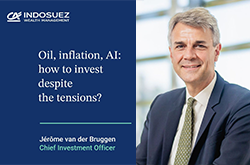
The new Era of Investment
Read the Monthly House View:
| English | French | Spanish | Italian |
| Chinese | Portuguese (Portugal) | Portuguese (Brazil) | Dutch |
Dear Reader,
For years, the dominant narrative in macroeconomics revolved around secular stagnation: a world rich in ideas but poor in investment. Innovation surged, yet capital spending lagged, leaving productivity growth anaemic and, in some regions, even declining. That paradox defined the post-global financial crisis era.
Today, however, the narrative has shifted. We are witnessing an acceleration in global capital expenditure (CapEx), reigniting hopes of a sustained productivity revival. What explains this reversal? The answer lies in a confluence of powerful forces reshaping corporate incentives.
First, the technological frontier—most notably artificial intelligence (AI)—is transforming the economics of investment. AI offers not only automation gains, but also new avenues for product development and business models. Many companies are using this as an opportunity to rethink their processes. The expected returns on investment in digital infrastructure, data ecosystems, and compute capacity have risen significantly. In such an environment, deferring investment risks obsolescence.
Second, the geopolitical landscape has altered corporate decision-making. Since the COVID-19 pandemic, firms have been confronted with repeated shocks: supply chain disruptions, trade frictions, and the growing use of economic tools as instruments of geopolitical leverage. The result is a heightened focus on resilience and strategic autonomy. Efficiency, long pursued through global optimisation, is now balanced against security of supply and operational continuity. This shift is inherently CapEx-intensive, as it requires re-shoring, duplication of production lines, and investment in alternative logistics and sourcing networks.
Our Focus article (page 8) illustrates this dynamic through the lens of the shipping industry’s response to the Hormuz episode. The vulnerabilities in chokepoints can no longer be treated as tail risks. Instead, they require proactive mitigation through infrastructure investment and strategic diversification.
Financing this wave of CapEx is a key aspect of the new era. As explored in our Market Views (page 10), an increasing number of companies are turning to equity markets rather than relying on cash flows or debt. This trend reflects the scale of investment needs. At the same time, central banks remain a stabilising force. Their actions since 2022 have demonstrated a clear commitment to price stability and institutional independence. As inflationary pressures re-emerged this year, they have signalled their readiness to act decisively. In our view, this credibility anchors inflation expectations and helps contain the risk that the current investment boom translates into sustained price pressures.
Taken together, these elements point to a structural shift rather than a cyclical uptick. The alignment of technological opportunity, geopolitical necessity, and financial adaptability is driving a broad-based and durable CapEx cycle. Unlike in previous decades, investment is no longer constrained by a lack of demand or confidence; it is propelled by the imperative to adapt.
Our investment strategy reflects this new reality. We remain constructive on equities, as companies positioned to benefit from this CapEx wave—and to deploy it effectively—are likely to deliver superior returns. At the same time, the complexity of the environment calls for robust diversification across sectors and geographies.
After years of hesitation, the global economy appears to have rediscovered the power of investment. If sustained, this CapEx cycle could mark the beginning of a new era of productivity growth—and a decisive end to the stagnation narrative that once seemed so entrenched.
We hope you find reading this month’s publication pleasant and insightful.

Monthly House View, 01.07.2026. - Excerpt of the Editorial
June 30, 2026